General insurance renewal management: a workflow that stops missed renewals
- Most missed renewals are a visibility problem: the expiry date lives in one person's inbox or spreadsheet.
- Put every policy due in a month on one list as soon as it enters the renewal window, typically 60 days before expiry.
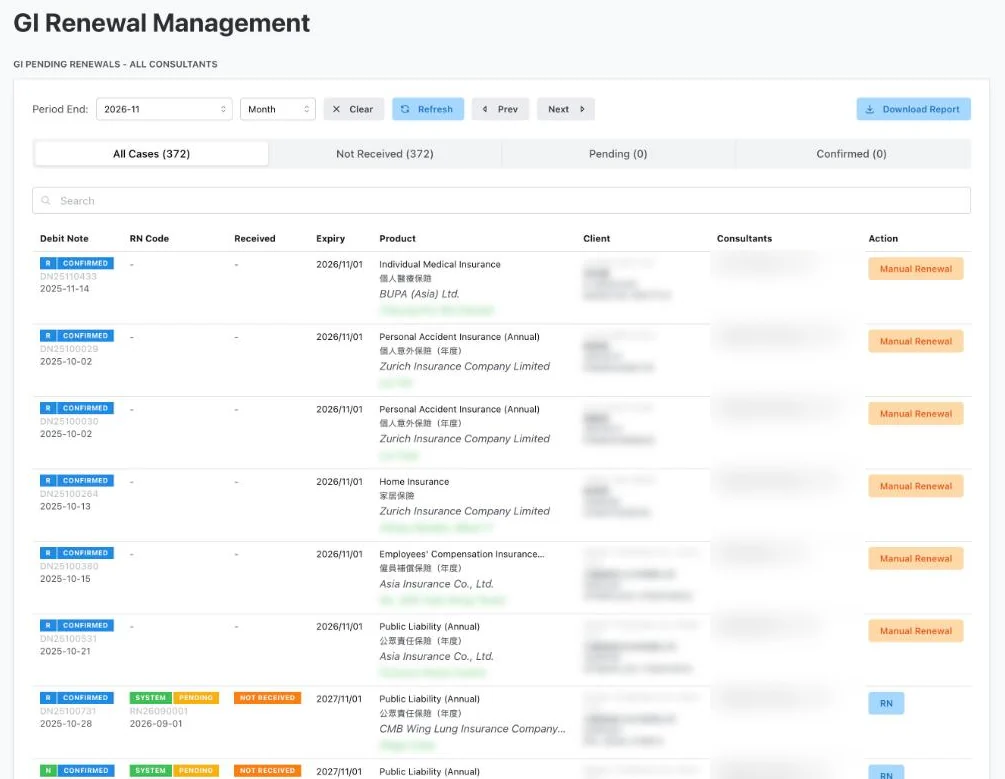
- Use three statuses: Not Received, Pending and Confirmed. Anything still Not Received close to expiry needs action today.
- Review a monthly renewal report: what renewed, what lapsed, and why.
Why renewals slip
For a general insurance broker, renewals are the most predictable revenue in the book. Every expiry date is known a year in advance. Renewals still get missed because the work is spread across people and inboxes: the insurer's renewal notice goes to one consultant, the client's changed details go to another, and the handler only hears about it when the client calls after cover has ended.
The fix is less about effort and more about visibility. Every policy due for renewal should be on one shared list, with an owner and a status, well before the expiry date.
A 60-day renewal workflow
| When | Step | Status |
|---|---|---|
| 60 days before expiry | Policy appears on the month's renewal list with its consultant and handler. | Not Received |
| 45 days | Request renewal terms from the insurer. Check with the client for changes in sum insured, payroll, vehicles or locations. | Not Received |
| 30 days | Terms received. Prepare the renewal proposal and, where needed, alternative quotes. | Pending |
| 14 days | Client confirms. Issue instructions to the insurer and record the renewed policy. | Confirmed |
| Month end | Download the renewal report and review results. | – |
Adjust the lead times to your book. Large commercial risks such as property, employees' compensation or contractors' all risks often need longer, because the client must supply updated information and the insurer may re-underwrite.
Three statuses are enough
- Not Received: the renewal is on the list but no terms have arrived. This is the column to watch.
- Pending: terms are in, the client is deciding or alternatives are being quoted.
- Confirmed: the client has agreed and the renewal is placed.
More statuses tend to blur who should act. With three, a manager can see in seconds which renewals have not moved.
The monthly renewal report
At month end, management should see, for each consultant and class of business:
- policies due, confirmed, still pending and lapsed;
- renewal premium compared with expiring premium;
- reasons for lapses, such as price, cover change, or the client moving to another broker.
Over a few months this report shows which classes and which insurers cause delays, which is more useful than any single month's retention rate.
Measures worth tracking
- Renewal retention rate: renewed policies divided by policies due in the period.
- Late-terms count: policies still Not Received 30 days before expiry.
- Lapse reasons: grouped, so patterns are visible.
How MBID handles renewals
MBID's GI Renewal module lists the policies due each month and sorts them into Not Received, Pending and Confirmed. Each renewal is linked to its client, insurer, consultant and handler, and alternatives can be run through GI Quotation. Management can download the renewal report at any point in the month, and each consultant sees the renewals they are responsible for in their own workspace.
Frequently asked questions
How early should a broker start a general insurance renewal?
A common practice is to put a policy on the renewal list about 60 days before expiry and request terms around 45 days before. Large commercial risks may need longer.
What statuses should a renewal list use?
Three statuses work well: Not Received (no terms yet), Pending (terms received, client deciding) and Confirmed (renewal placed).
How is renewal retention rate calculated?
Divide the number of policies renewed by the number of policies due for renewal in the same period.
This article is general information for insurance professionals and is not legal or regulatory advice. Check the Insurance Authority's current guidelines for your circumstances.